
Property development is the process of adding value to land or an existing home by building, renovating or subdividing it, then selling or renting the result. In NSW, a small project such as a granny flat or duplex needs council or certifier approval, a licensed builder and a GST plan before work starts. This guide is for homeowners and first-time investors weighing a project of that size. It explains the approvals, insurance, tax and cost lines you must plan for, so you can decide whether to proceed and what to ask a builder before you sign.
This guide covers NSW. Other states set different rules. It is general information, not legal, tax or financial advice, so confirm figures with the regulator or a qualified adviser before you commit money.
What is property development?
Property development is the process of increasing a property’s value by building, renovating or subdividing it, then selling or renting the finished result. In Australia the term covers everything from a backyard granny flat to a multi-storey apartment project. Small-scale property development, the kind most homeowners and first-time investors consider, usually means a granny flat, a duplex or a knockdown rebuild on a single lot.
Three things separate a development from an ordinary renovation. The goal is a financial return, not only a better home. The work usually needs planning approval, not just a contractor. And the tax treatment changes, because the Australian Taxation Office (ATO) generally treats the sale of new residential premises as a taxable supply for GST.
This guide focuses on the project types KK Global Constructions Group delivers as a licensed NSW builder based in Condell Park: custom homes, renovations and granny flats. Large apartment projects, commercial developments and projects outside NSW follow different rules and sit outside its scope.
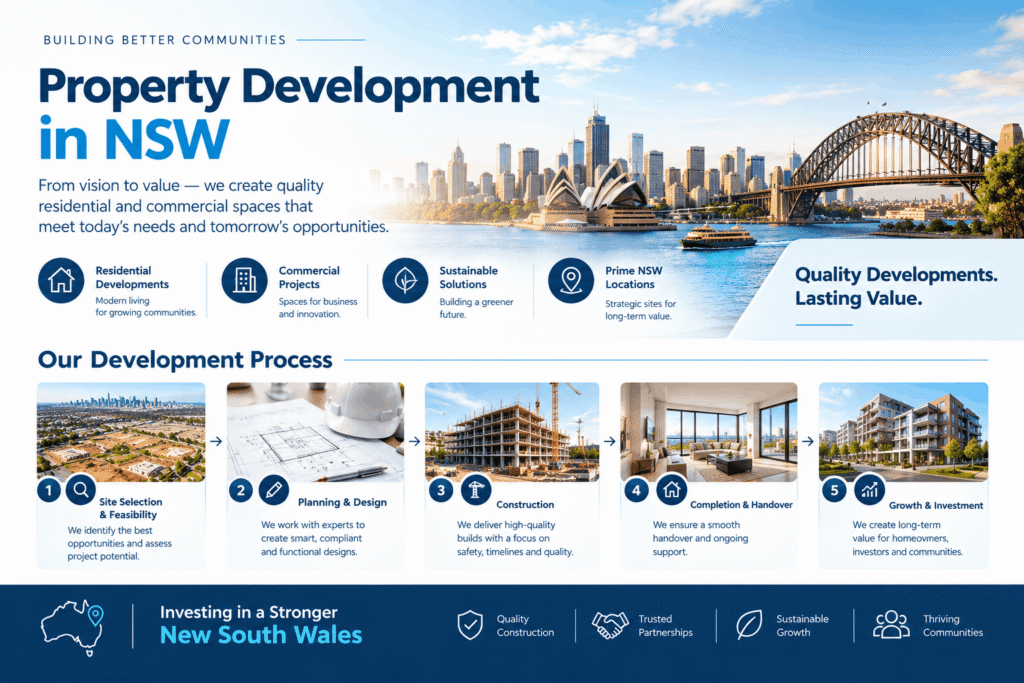
What types of property development can a small investor do in NSW?
Small-scale property development in NSW most often means a granny flat, a dual occupancy (duplex), a manor house or terraces, or a knockdown rebuild. Each type follows a different approval path and has different size limits. Your lot size, zoning and budget decide which one fits, so check the zoning on the NSW Planning Portal before you commission any drawings.
| Project type | Usual approval path | Key limits in NSW | Outcome |
| Granny flat (secondary dwelling) | Complying development certificate (CDC) or development application (DA) | Lot of at least 450 m² for a CDC. Floor area generally up to 60 m². One per property. | Rental income. Cannot be subdivided from the main house or sold separately. |
| Dual occupancy (duplex) | CDC under the Low-Rise Housing Diversity Code, or a DA | Up to 2 storeys. Only in zones where the council’s local environmental plan (LEP) already permits it. | Two dwellings on one lot. Whether the lot can be subdivided varies by council. |
| Manor house or terraces | CDC under the same code, or a DA | Up to 2 storeys. Only where council zoning permits multi-dwelling housing. | Several dwellings on one lot. |
| Knockdown rebuild | DA or CDC, depending on scope and site | Heritage, flood and bushfire controls can change the approval path. | Owner-occupied home or sale. |
A dual occupancy is not a granny flat. NSW defines a dual occupancy as two dwellings on one lot and excludes a secondary dwelling from that definition. The difference matters when you plan to sell, because a granny flat stays with the main house. The Department of Planning’s secondary dwelling guidance sets out the lot size and subdivision rules.
Renovation-led projects follow their own logic. Our article on a home renovation designed around the way you live covers the design side of that decision. The services page lists the custom home builders, home renovations and granny flat builders work that KK Global Constructions Group offers.
How does the approval process work for property development in NSW?
Most property development in NSW needs either a development application (DA) assessed by council or a complying development certificate (CDC) issued by council or a private certifier. Any development that is not exempt or complying needs a DA. Both pathways are lodged online through the NSW Planning Portal.
A CDC is the faster route. The NSW Department of Planning says approval can be issued within 20 days when a proposal meets every standard in the Low-Rise Housing Diversity Code. Miss one standard and you must lodge a DA instead. A DA means council assessment, possible neighbour notification and a longer wait.
The usual sequence looks like this:
1. Check zoning. Look up your lot’s zone and planning controls on the NSW Planning Portal and in the council’s local environmental plan.
2. Ask the council. Many councils offer a pre-lodgement meeting where planners flag problems before you pay for full plans.
3. Prepare plans and reports. Your designer or builder produces the drawings and the supporting documents that council or the certifier requires.
4. Lodge online. Submit the DA or CDC through the NSW Planning Portal and pay the fees.
5. Answer requests. Council or the certifier may ask for more information before deciding.
6. Receive the determination. A DA ends with a notice of determination. Construction cannot start until you hold the approvals and a construction certificate.
7. Build and close out. A principal certifier inspects the work, and you apply for an occupation certificate at the end.
If council refuses a DA, you can ask for a review or appeal to the NSW Land and Environment Court. KK Global Constructions Group sets out its own stages, from consultation to handover, on the process page, and approvals sit inside step two, Design and Planning.
Do you need a licensed builder for property development in NSW?
Yes. For any property development in NSW, Fair Trading requires a licence for residential building work valued at more than $5,000 including GST for labour and materials. Specialist work such as electrical wiring, plumbing, drainage, gasfitting and air conditioning needs a licence at any value. You can check a builder’s licence for free on the Fair Trading website before you sign anything.
The Fair Trading licence check shows the holder’s name, licence number, categories, expiry date and any cancellation or suspension under the Home Building Act 1989. Run the check yourself, using the number the builder gives you in writing. Fair Trading also advises asking for references and examples of past work.
Licensed home builders cost more than an unlicensed operator on paper. The gap reflects who carries the risk. A licensed builder holds insurance and legal responsibility for the work, and an unlicensed one leaves that risk with you.
KK Global Constructions Group states that it is a fully licensed builder in NSW with comprehensive insurance cover.
What is home building compensation cover, and who has to buy it?
Home building compensation (HBC) cover is NSW’s compulsory insurance for residential building work valued over $20,000 including GST. The builder buys it from icare HBCF, the only provider, and must give you the certificate before taking a deposit or starting work. It protects you if the builder becomes insolvent, dies, disappears or has their licence suspended for ignoring a tribunal or court order.
The cover has limits, and many guides skip this part. The policy pays up to $340,000 per dwelling, but non-completion claims are capped at 20% of the contract price. On a $700,000 contract, the most you can claim for unfinished work is $140,000. You must claim it within 12 months. Defect cover runs for six years for major defects and two years for general defects.
Any property development that hires a builder for more than $20,000 triggers this cover. Subcontractors do not need their own cover, because the head contractor’s certificate covers the job. Ask for the certificate showing your property’s address, then confirm it with the HBC check on the Service NSW home building compensation page. The icare HBCF scheme page explains the policy terms.
Can you be your own builder on a property development?
You can act as your own builder, but only with an owner-builder permit from NSW Fair Trading for work valued over $10,000. The permit is not a builder’s licence. You carry the same legal responsibility for the work as a licensed builder would. Work valued at $20,000 or more also requires an approved owner-builder course.
Fair Trading limits the permit to single dwellings, dual occupancies in special circumstances and secondary dwellings that need a DA or CDC. You must give your principal certifier a copy of the permit before work starts, and the certifier cannot inspect without it.
The trade-off in owner-built property development is simple. You save the builder’s margin, but you take on defect liability, trade scheduling and site safety duties. Selling an owner-built property also brings extra requirements, so read the owner-builder permit rules before you buy the land. This route does not suit anyone who plans to build and sell quickly without construction experience.
How does GST work on property development?
Selling new residential premises is generally a taxable supply, so the seller owes GST on the sale. The margin scheme can reduce it. Under the scheme, GST becomes one-eleventh of the margin, which is the sale price minus the land’s original cost, instead of one-eleventh of the full price. Buyer and seller must agree to use it in writing before settlement.
The ATO publishes a worked example of the margin scheme:
| Item | Amount |
| Sale price of the new house | $800,000 |
| Land price paid in 2009 | $228,000 |
| Margin (sale price minus land price) | $572,000 |
| GST payable ($572,000 divided by 11) | $52,000 |
| Withheld by the buyer at settlement (7% of price) | $56,000 |
| Refund to the developer through the BAS | $4,000 |
Source: ATO, GST at settlement.
Since 1 July 2018, most buyers of new residential premises pay the GST straight to the ATO at settlement. For margin scheme sales the buyer withholds 7% of the contract price. The developer then reports the actual GST in the business activity statement (BAS) and receives the difference back, as in the example above.
Whether a one-off project counts as an enterprise depends on the character of the activity. An ATO Community answer states that a private owner who subdivides land and builds new homes for sale can be carrying on an enterprise, even without GST registration. Margin scheme eligibility also depends on how you bought the land. Speak to a registered tax agent before you sign the sale contract.
How much does a property development project cost?
A property development budget has nine cost lines, and the construction price is only one of them. Land, approvals, site works, insurance, GST, holding costs, selling costs and a contingency come on top. The total depends on site conditions, size and finishes, so a reliable figure comes from a written quote and a feasibility worksheet, not from an average.
| Cost line | What it covers | When you pay |
| Land | Purchase price, transfer duty, legal and conveyancing fees | At settlement |
| Design and approvals | Plans, reports, DA or CDC fees, certifier fees | Before construction starts |
| Site works | Demolition, earthworks, utility connections | During construction |
| Construction | The builder’s contract price, paid in stages | On the contract’s progress payment schedule |
| Insurance | HBC cover and site insurances. Confirm whether the quote includes them. | Before work or deposit |
| GST | Full GST or the margin scheme amount on sale | At settlement and in your BAS |
| Holding costs | Loan interest, council rates, land tax | Monthly or quarterly |
| Selling costs | Agent commission, marketing, legal fees | At sale |
| Contingency | Allowance for variations, delays and price rises | Held in reserve |
Property development budgets also need a material buffer, because cut-offs and breakage are unavoidable. Our note on material ordering allowances is a useful read before you compare quotes. A quote that assumes exact quantities deserves a question.
The profit formula is short: expected sale price, minus GST payable, minus every cost in the table. A thin result can disappear after a small cost rise or a three-month delay in holding costs. Copy the worksheet at the end of this guide and fill in your own figures.
Is property development right for you, and what are the risks?
Property development suits owners who have spare equity, can wait through approvals and can absorb a delay without selling in a hurry. It does not suit anyone who needs the proceeds by a fixed date. The main risks are a refused or delayed approval, cost overruns, longer holding costs, builder insolvency and a wrong GST assumption.
| Advantages | Risks |
| Adds value through new dwellings, such as rental income from a granny flat | Approval can be refused or take longer than planned |
| You control the design, finishes and timing | Costs can rise after the contract is signed |
| Complying development can cut approval time to about 20 days | Holding costs keep running while you wait |
| Compulsory insurance protects you if the builder fails | GST and income tax treatment can change the final profit |
Who this is not for: owners of lots affected by heritage, flood or bushfire controls should confirm feasibility with council first, because those controls can limit what is approvable. Buyers without a contingency fund should also wait.
How do you choose a builder for a property development project?
Choose a builder who holds the correct NSW licence, can show an HBC certificate for your address, offers a written contract with a progress payment schedule and can show finished projects like yours. Check each item before you pay a deposit.
1. Check the licence. Use the Fair Trading licence check and match the category to your work.
2. Ask for the HBC certificate. It must show your property’s address and must arrive before any deposit.
3. Read the contract. Residential building contracts over $20,000 must include a progress payment schedule. Fair Trading’s Consumer Building Guide must reach you before you sign a contract for work over $5,000.
4. Inspect finished work. Ask for references and visit a completed project of the same type.
5. Compare inclusions. Line up quotes item by item, including site works, allowances and exclusions.
6. Confirm the certifier. Ask who the principal certifier will be and when inspections occur.
KK Global Constructions Group builds custom homes, renovations and granny flats across NSW and offers real estate services for buyers, sellers and investors. Its projects page shows recent work, and the about us page describes how the company operates.
Frequently asked questions
Do I need council approval to build a granny flat in NSW?
Yes, you need approval, but not always from council. A granny flat can be approved as complying development by council or an accredited private certifier if it meets the Housing SEPP standards, including a lot of at least 450 square metres. A plan that misses a standard needs a development application.
Can I sell a granny flat separately from the main house?
No. A lot with a secondary dwelling cannot be subdivided, so the granny flat stays with the main house. If separate titles matter to your plan, look at a dual occupancy instead, and check your council’s subdivision rules first.
How long does a complying development certificate take?
The NSW Department of Planning says a certificate can be issued within 20 days when the proposal meets every standard in the Low-Rise Housing Diversity Code. Plans that fail a standard go through a development application, which takes longer because council assesses it. Timing also depends on how complete your documents are.
What is the margin scheme in property development?
The margin scheme is a GST method for taxable property sales. You pay GST of one-eleventh of the margin, meaning the sale price minus the land’s original cost, instead of one-eleventh of the full price. Eligibility depends on how you bought the land, and the buyer must agree in writing before settlement.
Do I have to register for GST on a one-off development?
It depends on whether your activity counts as an enterprise. The ATO says a private owner who subdivides land and builds new homes for sale can be carrying on an enterprise, even for one project. If so, the sale is generally taxable. Ask a registered tax agent before you sign any contract.
Is a duplex the same as a granny flat?
No. A dual occupancy is two dwellings on one lot, and NSW excludes a secondary dwelling from that definition. A granny flat is a secondary dwelling inside, attached to or separate from the main home. The two follow different rules for size, approval and subdivision.
What should you do before you commit to a project?
Confirm your zoning, build a feasibility worksheet, speak to an accountant about GST and then ask a licensed builder for a written quote. That order protects your money, because zoning and tax decide whether a property development project works before you pay for design. The same order applies to new home construction, a renovation or a granny flat.
KK Global Constructions Group offers a free consultation through its contact page. The team also provides real estate services, so you can discuss your property development and the property decision in one conversation.